India Squad for T20 World Cup 2026: Who Replaces Washington Sundar If Ruled Out?
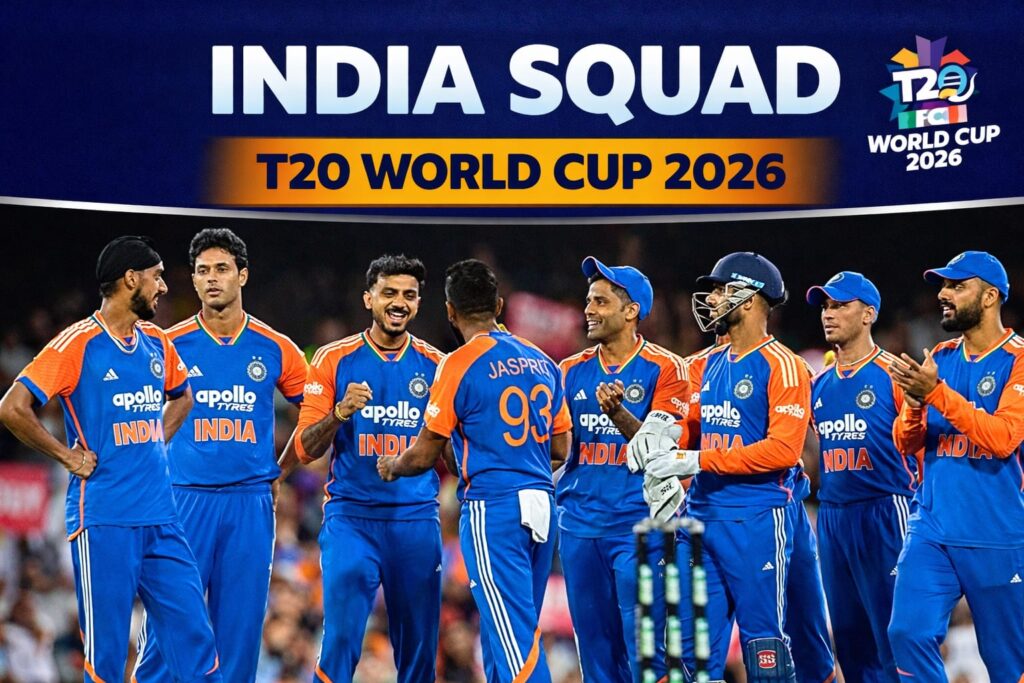
India Squad for T20 World Cup 2026: Who Replaces Washington Sundar?
The India squad for T20 World Cup 2026 looks strong, balanced, and explosive on paper. With the tournament set to be played in India and Sri Lanka, the defending champions are clear favorites to lift the trophy once again. However, a potential concern has emerged just weeks before the mega event — Washington Sundar’s fitness.
Washington Sundar, one of India’s most versatile spin all-rounders, is currently nursing a minor injury. While team management remains optimistic, contingency planning is already underway. The big question on every fan’s mind is simple:
If Washington Sundar misses out, who replaces him in the India squad for T20 World Cup 2026?
Table of Contents:
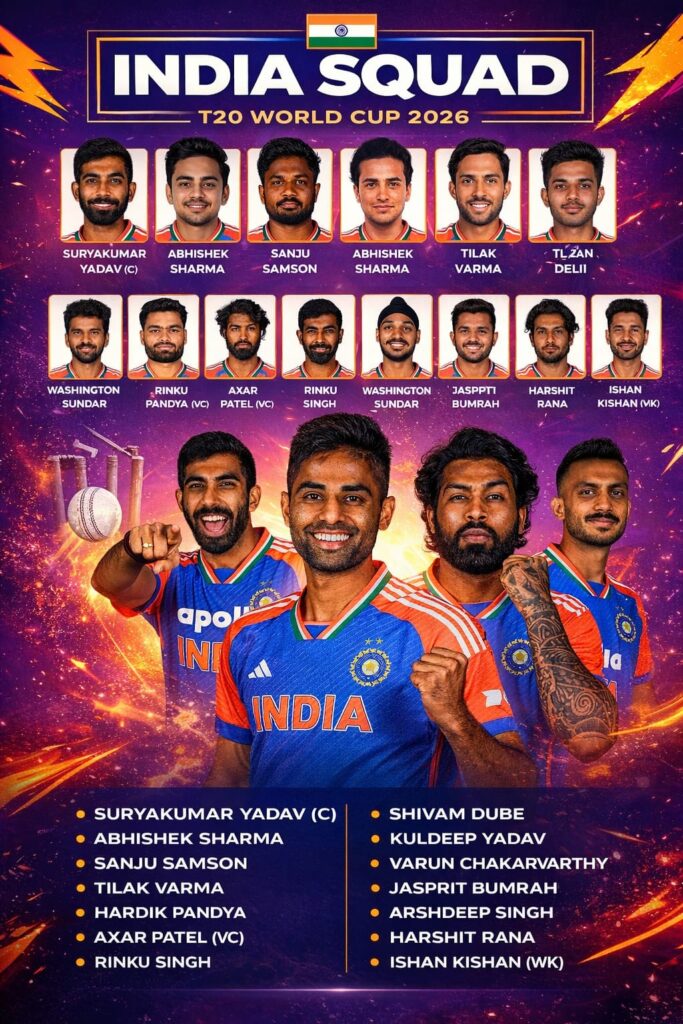
The Full India Squad for T20 World Cup 2026
Before discussing replacements, let’s take a quick look at the officially announced India squad for T20 World Cup 2026:
| Player | Role | Key Statistics (T20I) | Notable Strength |
|---|---|---|---|
| Suryakumar Yadav (c) | Batsman | 2,341 runs @ SR 171.55 | 360-degree strokeplay, finishing games |
| Abhishek Sharma | Opening Batsman | 426 runs @ SR 190.62 | Aggressive powerplay hitting |
| Tilak Varma | Top-order Batsman | 336 runs @ Avg. 33.60 | Anchor/Accelerator at No. 3 |
| Sanju Samson | Wicketkeeper-Batsman | 530 runs @ SR 136.75 | Flamboyant strokeplay, keeping |
| Shivam Dube | All-rounder | 363 runs, 8 wickets | Power-hitting vs spin, medium pace |
| Ishan Kishan | Wicketkeeper-Batsman | 796 runs @ SR 125.89 | Left-handed dynamism, aggressive start |
| Hardik Pandya | All-rounder | 1,348 runs, 73 wickets | Pace bowling, death overs hitting |
| Arshdeep Singh | Fast Bowler | 102 wickets @ Econ 8.61 | Powerplay specialist, death yorkers |
| Jasprit Bumrah | Fast Bowler | 101 wickets @ Econ 6.55 | World’s best death bowler |
| Harshit Rana | Fast Bowler | (New) | Raw pace, bounce, emerging talent |
| Varun Chakaravarthy | Spin Bowler | 58 wickets @ Econ 7.23 | Mystery spin, middle-overs weapon |
| Kuldeep Yadav | Spin Bowler | 72 wickets @ Avg. 13.27 | Wrist-spin, wicket-taking in clusters |
| Axar Patel | All-rounder | 50 wickets, 500 runs | Economical left-arm spin, lower-order hits |
| Washington Sundar | All-rounder | 41 wickets, 217 runs | Powerplay spin, handy batter |
| Rinku Singh | Finisher Batsman | 356 runs @ SR 176.23 | Ice-cool finisher, high-pressure player |
Washington Sundar’s role in this India squad for T20 World Cup 2026 is extremely specific — and that’s what makes his replacement such a tricky call.
Leadership and Captaincy: The SKY Era
Suryakumar Yadav ascends to captaincy for a World Cup with the unique pressure of defending a title at home. His leadership philosophy is an extension of his batting: fearless, innovative, and proactive. Having led India to several bilateral series wins, his calm demeanor under pressure and deep understanding of the modern T20 game make him the ideal leader for this campaign. His form with the bat remains crucial; as the world’s premier T20 batsman, his performances will set the tone.
A New-Look Core
The selection committee, led by Ajit Agarkar, has made several significant calls, moving away from some established names to build a squad specifically engineered for the conditions and demands of a home World Cup.
Batting Unit: Explosive from Top to Bottom
The Powerplay Destroyers
The opening pair of Abhishek Sharma and Sanju Samson is designed to maximize the fielding restrictions. Abhishek’s stunning strike rate of 190.62 in T20Is showcases his ability to tear attacks apart from the first over. Samson brings experience and flair, providing a right-left combination that disrupts bowling plans.
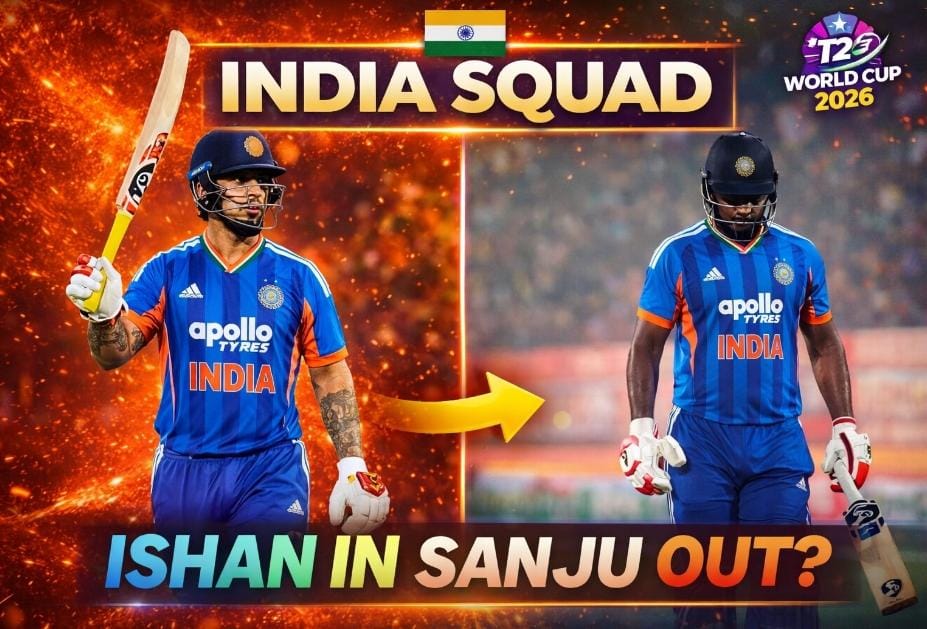
Ishan Kishan’s recall is a major storyline. After a stellar domestic season, including a match-winning 76 against New Zealand, he adds a crucial left-handed option at the top or in the middle order, and provides a secondary wicketkeeping option.
The Engine Room: Varma and SKY
At number three, Tilak Varma possesses a phenomenal average of over 60 in that position. His role is to stabilize if early wickets fall or to accelerate the platform set by the openers. He is followed by captain Suryakumar Yadav at four, the pivotal position where he can dictate the middle overs with his unparalleled range of shots.
The Finishers: Dube and Rinku
The lower-middle order boasts extraordinary firepower. Shivam Dube is a specialist spin-hitter, crucial for negating opposition slow bowlers in the middle overs on potentially turning Indian tracks. Rinku Singh has redefined finishing in Indian cricket. His strike rate soars to 214.68 in the death overs (16-20), making him one of the most reliable closers in world cricket.
Hardik Pandya provides the final punch, combining power with experience in high-stakes chases and first-innings finishes.
Bowling Attack: A Potent Mix of Pace and Mystery
The Pace Spearheads
Jasprit Bumrah is the undisputed leader of the attack. With over 100 T20I wickets and an economy rate of 6.55, he is the most complete bowler in the format, exceptional in the powerplay and lethal at the death. Arshdeep Singh partners him, offering swing upfront and precise yorkers at the end. His left-arm angle provides vital variation.
The inclusion of Harshit Rana is a bold, future-oriented pick. He adds raw pace and a height advantage, offering a point of difference on pitches that may favor batsmen.
The Spin Quartet: India’s Trump Card
Understanding home conditions, India has packed its squad with four distinct spin options:
- Kuldeep Yadav (Wrist-spin): A genuine wicket-taker with a stellar average.
- Varun Chakaravarthy (Mystery Spin): Unreadable for many batters, perfect for stifling runs.
- Axar Patel (Left-arm orthodox): Economical and accurate, also a capable hitter.
- Washington Sundar (Off-spin): A powerplay specialist to exploit match-ups.
This variety allows Captain SKY to attack any batting line-up throughout the 20 overs.
Selection Surprises and Omissions
The most notable omission is Shubman Gill. Despite being vice-captain not long ago, a dip in T20I form and strike rate has seen him sidelined for a more aggressive template. The selectors have clearly prioritized power and momentum from ball one.
The return of Ishan Kishan over other contenders like Ruturaj Gaikwad or Yashasvi Jaiswal indicates a preference for a left-handed aggressor with point-of-difference keeping skills.
The choice of Harshit Rana over more experienced pacers like Mohammed Siraj or Mohsin Khan is a vote for X-factor and pace.
Injury Watch: Sundar and Varma
Both Washington Sundar and Tilak Varma are currently managing minor niggles during the ongoing New Zealand series. Team management and the National Cricket Academy (NCA) are confident of their full recovery before the tournament begins on February 9, 2026.
Contingency Plan: Should Sundar be unavailable, India has multiple within-squad options. Axar Patel can directly fulfill the role of a bowling all-rounder. Alternatively, the team could look to add a pure batsman or an extra pacer from the reserves, with someone like Riyan Parag or Ravi Bishnoi being a like-for-like spin replacement.
Why Washington Sundar Is So Important to India’s Balance?
Washington Sundar isn’t just another squad member. He provides three-dimensional value:
- Powerplay off-spin against left-handers
- Calm lower-order batting
- Sharp fielding
- Match-ups against teams like England, Australia, and South Africa
In Asian conditions, his ability to bowl economical overs in the powerplay is priceless. Losing him would force India to rethink combinations.
Scenarios If Washington Sundar Is Ruled Out:
If Sundar is unavailable, selectors have three broad options:
- Replace him with a spin-bowling all-rounder
- Add a pure spinner
- Strengthen batting or pace instead
Let’s analyze each route in detail.
How This Impacts India’s Title Chances?
Even without Washington Sundar, the India squad for T20 World Cup 2026 remains incredibly strong.
Key reasons:
- Explosive top order
- Best death bowling attack in the world
- Multiple spin options
- Home crowd advantage
India’s depth allows them to absorb injuries better than most teams.
Home Advantage: The Deciding Factor?
India’s record at home in T20Is is formidable: 71 wins out of 103 matches. Playing in familiar conditions, with crowd support across venues, provides an intangible boost. The squad has been picked to exploit slow pitches, big boundaries, and known dew factors.
Key Home Venues for India:
- Wankhede Stadium, Mumbai: Batting paradise, favors high scores.
- Arun Jaitley Stadium, Delhi: Traditionally slow, aids spin.
- M. Chinnaswamy Stadium, Bengaluru: Small boundaries, high-scoring ground.
- Narendra Modi Stadium, Ahmedabad: Mega-stadium for knock-out games.
Comparison with Key Rivals
| Team | India’s Edge | Potential Challenge |
|---|---|---|
| Australia | Superior spin attack for subcontinent conditions. | Australia’s power-hitting depth. |
| England | More balanced bowling unit, especially spin. | England’s ultra-aggressive batting philosophy. |
| South Africa | Deeper batting line-up and finishing power. | SA’s high-quality pace attack (Rabada, Nortje). |
| Pakistan | Greater experience in Indian conditions (IPL). | Pakistan’s unpredictable X-factor players. |
Path to the Trophy: Group Stage and Beyond
India is placed in Group A alongside Pakistan, USA, Netherlands, and Namibia. While on paper it seems straightforward, the opening clash against Pakistan is always a high-pressure encounter that sets the tournament’s momentum.
The expected path is:
- Top 2 in Group A (Highly likely).
- Super 8 Stage: Tactical match-ups become key, where the variety in the squad will be crucial.
- Semi-finals & Final: Where experience, handling pressure, and individual brilliance decide the champion.
T20 World Cup 2026 Warm-Up Matches Full Schedule:
FAQs: India Squad for T20 World Cup 2026
Q1: Who is the captain of India Squad for T20 World Cup 2026?
A1: Suryakumar Yadav (SKY) will captain the side, bringing his innovative and fearless approach to leadership.
Q2: Why was Shubman Gill dropped?
A2: Gill was omitted due to a below-par T20I strike rate in recent times. The selectors opted for a more aggressive template, favoring openers like Abhishek Sharma who score at a faster pace from the start.
Q3: Who are the wicketkeepers in the squad?
A3: The squad includes Sanju Samson (primary) and Ishan Kishan as the wicketkeeping options.
Q4: What is India’s biggest strength in this squad?
A4: The incredible depth and power in batting, combined with a versatile and varied spin attack tailored for home conditions.
Q5: Can India win back-to-back T20 World Cups?
A5: No team has ever won consecutive T20 World Cups. With a balanced squad, home advantage, and proven match-winners, India has a very strong chance to create history.
Q6: When does India play its first match?
A6: The full schedule is awaited, but India’s first match in Group A will be in early February 2026.
Final Verdict
The India squad for the T20 World Cup 2026 is a perfect blend of audacious intent and strategic selection. It is a squad built not just on reputation, but on current form and specific role clarity. From Abhishek’s fury at the top to Rinku’s calm at the death, from Bumrah’s yorkers to Kuldeep’s tricks, every box appears checked.
The India squad for T20 World Cup 2026 is stacked with match-winners, and Washington Sundar’s potential absence, while concerning, is far from disastrous. India’s bench strength, adaptability, and familiarity with conditions ensure they remain the team to beat.
Whether selectors opt for experience, balance, or aggression, one thing is certain — India is coming into the T20 World Cup 2026 with serious intent.
If Sundar returns fit, it’s a bonus. If not, India still has answers.
About The Author